Wednesday, October 5, 2011

Deviate From The Norm

Take The Path Less Traveled-

As I sit here trying to think of what would best be considered 'deviant' to write about, it dawns on me that over the past few decades the line between 'deviancy' and 'the norm' has been so far obscured that it's almost impossible to tell what would actually fall into that category. In today's world, there are so many people from various different walks of life all living in the same space that what once may have been considered deviant behavior is now something you see every day on the streets. Whether we realize it or not, most of the people we meet deviate from what many consider to be 'the norm' at least a few times throughout their lives. Most of them probably even break 'the norm' on a daily basis. But what would really define 'normal' these days? In a major city like Philadelphia, deviancy has practically become the new norm. I can think of no better example than myself.


Believe it or not, I'm actually at work in this picture.
 
Looking back, I realize that whether I ever knew it before or not, I've consistently been deviating from what many would consider a 'normal life path' for the better part of the past decade. Even now, when people ask me what I do for a living, they often don't believe me because my job sounds so unrealistic and so outside of 'the norm' for someone my age (or anyone for that matter) that I must be making something up. What do I do you ask? I'm Editor in Chief for a major comic book website (Comicbooked.com). That’s right, my job is to read and write about comic books, and I do all of this while still working on my bachelors degree, all because I deviated from 'the norm' and quit my day job to follow my dreams.


My life was never necessarily easy in high school, and during my first few years I had to deal with the death of a parent as well as a highly debilitating illness (no worries, I've since gotten better) that prevented me from going to school on a regular basis. By the time I was sixteen, my grades were completely shot due to poor attendance, and any chance I had of getting into a good college went right out the window. By age seventeen I had completely dropped out of high school and had stopped doing a whole lot of anything with my life. I spent the better part of a year just hanging out with my friends, playing video games, playing guitar and reading comics; essentially living the teenage dream. Outside of my own father, no one really supported me in my decision to do any this, and the majority of the people in my life looked at me with a certain stigma because I wasn't doing what they considered the be the right thing or 'the norm'. I eventually figured out that I wanted more from life and took steps to go back and finish school of my own volition, graduating with top marks and moving on to college, where you can find me today. I honestly don't think I would have made it as far as I have in life if I didn't drop out of school for that year to figure out who I really was. Deviating from the usual path most people follow probably saved me from a life of misery and helped to catapult me into every geeks dream job.

So what is 'normal'? Who really decides what 'the norm' is and sets that standard? Society may have its standards that we’re all subliminally expected to live by, but as the world grows and society evolves, we're going to be seeing a lot less normalcy and a lot more deviation.


-Jordan DesJardins

Nose Pickers and Boogie Eaters

By Kevin Rogers

"You can pick your friends but you can't pick your friends nose," is a common saying in most English speaking countries and nose picking is a common habit many people have throughout the world. Most people would try not to pick their nose in public and may be embarrassed and mocked. From young ages people learn not to pick their noses and may get teased if they do and for good reason. It's disgusting. Picking your nose in public is considered deviant. It's such an odd and gross thing to do. I've even seen videos of people doing this made fun of on "Tosh.O" and other television programs.
Not only does nose picking cause some health issues like more frequent nose bleeds but it can have its benefits. Dr. Friedrich Bischinger says that nose pickers are happier, healthier, and probably more in tune with their bodies. The doctor adds that the finger can clean the nose a lot better than a handkerchief or tissue ever would. Even eating boogers can improve your immune system. Children that eat them can grow up to have stronger bodies. Booger eaters also rarely get sick, and may never gotten an ear infection or the flu. Dr. Bischinger encourages children to pick their noses because not only is it healthier but its the natural response as humans.

Since nose picking and boogie eating is healthier could this deviant act become a norm? I doubt but i think its pretty interesting.


Stigma

by Brittni M. Green

About two years ago I was sitting in a cafe and happened to over hear a conversation between two males.  The one boy was commenting on the other boys haircut saying he looked nice.  The other boy responded by saying something along the lines of "thanks man".  Then the boy quickly responded back and said "NO HOMO OF COURSE!" It didn't take me long to figure out what was meant by that and I have to admit I was a little upset.  My name is Brittni Green and  recently I've been educating myself all about stigmas and in particular the stigma of being a homosexual  male.

So I didn't grow up in an urban area.  I moved to Philadelphia about a year ago and now I've heard the phrase more than I can even count.  For those of you who don't know what the phrase "no homo" means its a phrase one says to make it clear to the listener that he had no homosexual intentions.  Ive also heard girls say it to other girls.  Anyway even being suspected of being gay is considered the worst thing ever to most males especially young black males in particular.

I'm writing this to take my stand against the stigmatization of gay men. Gay men shouldn't be treated differently or unfairly or treated as if they are below straight men. A lot of African American women have negative attitudes towards gay males because they see themselves in competition for a limited amount of suitable black male partners.  This stigmatization of homosexual men causes the "closet" attitude. A lot of gay men struggle with discrimination, their family and friends don't understand and sometimes don't want to even try to understand. And sadly most gay men feel as if things will never get better. A lot of gay males have lost their life because they were gay some of the deaths were even unfortunately self inflicted.

In essence, I hope this country in the early stages towards better attitudes of homosexual men. We cannot be the cause of another young death due to this stigma.

 
Thanks for reading

Monday, October 3, 2011

Crime on the Streets of Philadelphia

By: Edmund Celia

Do you remember the lawless flash mobs in Philadelphia? On Aug. 9, 2011 a flash mob gathered on South Street in Philadelphia. You can see the crimes being committed in the videos below. For example, a group of deviants are kicking and punching someone on the ground next to a car. Assault is a crime and flash mobs committing them are a community issue that is deplorable in our society, and cannot be taken lightly. It’s also against the law to attack people. Moreover, you can see in this first video how fast a counter culture is formed with modern technology. Case in point, this group of teenagers are going against main stream culture, and committing crimes of assault. In addition, this video also shows the bystander effect happening. For example, it is when a crime takes place and, because a large group of people are there standing around and watching; they don’t call for help or call the police. They think that someone else will call for assistance. As a result, no one helps the victim. Additionally, the Mayor of Philadelphia was initially subjected to ethnocentrism, and the crowd not calling for help was exposed to the bystander effect. These sociological effects are unknowingly exposed in the below video. 
Mayor Michael Nutter was originally in denial about the Philadelphia flash mobs as something not deviant or criminal, because the group that formed was of his own ethnicity. Furthermore, my above video is a perfect example of this. It is called ethnocentrism and it is cause by one’s shared culture. Our Mayor, Mr. Michael Nutter says, “Not a whole lot happen.” Meanwhile, the video shows the criminal activity and clear evidence of two assaults that took place on South Street. The first assault was a man that was interviewed and you can see his bruises. In addition, the news reported that a woman was attacked for no reason. Our Mayor indirectly says in the video, that he blames his misunderstanding of the crimes that were committed by the flash mob on the wrong official facts being reported, but not the news media. This is just another example of ethnocentrism- when one cannot see something from a world view, because it is happening from within one’s own group.


Furthermore, I also think that ethnocentrism and the bystander effect are unjust and wrong. It’s also a shame that people sometime suffer from these sociological effects. For example, ethnocentrism is that one may be close-mined to reality, and the bystander effect is when a large group of people witness a crime and nobody steps in to help the victim. In my opinion, these sociological effects are also criminal. 

To conclude, I agree with the police commissar, Chief Charles Ramsey in the second video above. He says, “It’s no joke, and if you do think it is, you have another thing coming. It is serious crime(s) being committed.” Criminal or deviant behavior, such as, attacking another human being is unacceptable in our society. As a result, these juvenile delinquents deserve to be held accountable for their crimes and actions, and are lucky no victims were killed. 

Saturday, October 1, 2011

Bob Smith: Is not being part of an in-group really just another in-group?

My post is related to personal experience with in-groups as opposed to research on the subject.  There is already a thoughtful post on the nature of these kinds of groups and their impact so I'll try to go in a different direction to add to the discussion.

In 1989, I was the first and only person in my rural high school of 600 students to be openly gay.  I don't mean 600 students in my class, as most urban kids are used to.  I mean 600 children from grades 7-12 in one building.  The small class sizes made for some seriously tight in-groups and being ostracized for being different had a bigger impact because of that.  There were no gay student groups and no discussion about it at all except the daily ridicule, scorn and violence that I received from my fellow students and to some degree even the teachers. 

Needless to say, I did not fare well trying to be part of the in-groups of my school.  I was my own little out-group and in respect to my orientation the only person like me that virtually everyone in my school had ever encountered.   Even the out-groups became impenetrable cliques to me for the most part.  Stoners, band geeks, and even the truly unpopular kids forced in to the back corner at lunch wanted very little to do with me because of the stigma placed on me by more popular kids in the school.  I did my best to go my own way and get on with my day, just waiting to go home and get away from all the in-groups I couldn't get in to.

What I found after a while though was that there were other kids who kind of fell through the cracks of these groups.  For example, there were 4 kids in my school who were skaters, and one or two who identified as goth.  They really didn't have a lot of people in their out-group and often they were all different ages so didn't sit together in class or get much opportunity to  band together against larger, more popular groups.  So what ended up happening was that we started to talk to each other based on our mutual feeling of oppression and exclusion.  Suddenly, kids who didn't really have anything in common with me at all were watching out for me in the hallways and defending me against bullies or I would find myself helping other kids work through their sense of alienation or stepping in to prevent them from being abused at home.  Our only real sense of identification with each other was actually because we were all treated the same by the larger groups.  That is to say, they hated us for different reasons but they treated us all equally badly because of it. 

Years later, I would realize how much that really shaped me in my willingness to open up to people and how much this strengthened my ability to identify with people who were different from me.  Conversely, I saw through facebook and acquaintances who kept in touch with the various in-groups and cliques of our old school what really happened to those popular kids.  For the most part, they were so comfortable and complacent being at the top that they were unable to adjust to life after high school which demands that you be open and adaptable.  A large majority of them never left the comfort of our small home town- despite the fact that jobs are less and less available and the quality of life is severely limited by its isolation.  They live small, unimportant lives with no real chance of advancement, while my in-group of outcasts have all (every single one!) gone on to wide-open lives and amazing opportunities that were only made available to us because we learned to respect other people's differences the hard way.  The world works on diversity and has increasingly come to value that.  I can only thank god that I wasn't one of the popular kids in school. I might have ended up stuck in a dying town with no real prospects for a decent life.  Sometimes you're so out, you're in.


Friday, September 30, 2011

Our Future of Fast Food


I can already predict how the future will be.  Soon people won’t even have to step out of their houses or go out of there way for the little things. We’ll eventually have some kind of technology that when we press a button and say what we want it will materialize right in our faces. No more running out the convenient store to pick something up, or stopping at a fast food joint for a quick pick me up. Sooner or later that will be too slow for us. After all, why do that when the new way is faster. This is what our society is all about, mcdonaldization, or the increasing presence of the characteristics of a fast food restaurant in our daily life. These main characteristics include efficiency, calculability, predictability and control.

What are the great things about McDonald’s that people love? They’re fast with everything, you know exactly what’s on the menu, and they never run out things. When you go to McDonald’s you can be in and out in 5 minutes. People like the fact that everything is routine. It is all made easier for customers, you just order and you’re out the door. Due to this fact, McDonald’s gets a lot of business which gets them a lot of money. So it’s understandable that the rest of the world wants to join in on that success. I think this will be the death and birth of our society; the death of anything personal, and the birth of the new speedy future, where quantity surpasses quality.  Everything new being created is all to make things easier and faster for the customer. Workers will soon be replaced by robots that can be completely controlled and will eliminate any chance of the unexpected that usually comes with a human. Part of me likes the mcdonaldization idea especially when I’m in a rush somewhere, then rapid service comes in handy. However, I prefer the way of life that doesn’t promote laziness.  If people want books, they don’t even have to go to the bookstore anymore; they can just download onto their Nook or Kindle.  Shopping is made easy by just turning on your computer. People don’t even have to grocery shop anymore, they can call ahead of time and have an employee collect their goods for them so they can drive by and pick them up. It’s insane, but it’s smart because it brings in the business.

So, McDonaldization is growing fast and will soon shape our society into its new form. The efficient service, the quantity being served, the predictability and control, are the new dimensions or our world. This fast-food model is dominating our culture and soon we will all be adapted to this new robotic future and our past will diminish.
By: Ariel Dezio

Thursday, September 29, 2011

In-Groups and Out-Groups

by Joe Patrone

Needless to say, relationships between groups of people can be highly unpredictable. Even though you can almost determine the overall effect that attitudes, environmental stimuli, and even slight differences in personality can twist one's expectations around. This begs the question why people in  groups act the way they do. Specifically, one could ask why people in in-groups display altruism towards other members of the group while viewing people outside of the group as unimportant or lowly-- or conversely, why people in out-groups feel competitive towards the in-group.

Charles Darwin states in his second book, The Descent of Man:
 "A tribe including many members who, from possessing in a high degree the spirit of patriotism, fidelity, obedience, courage, and sympathy, were always ready to aid one another, and to sacrifice themselves for the common good, would be victorious over most other tribes; and this would be natural selection."
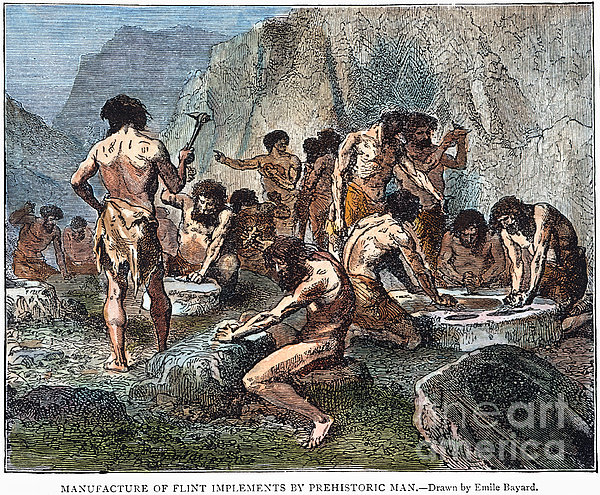
So, in other words, forming a group and staying loyal to its members has an evolutionary premium. This is also approached by members of the scientific community in the field of evolutionary psychology. Because highly social behavior increased early mans' odds of survival in the wild the human brain became more and more adaptive to responding to group behavior over time. This isn't hard to believe considering how people behave in modern times!


A drawing of early man depicting highly
social behavior. One advantage of having an extremely social group would be the invention and distribution of stone tools and weapons.


This still doesn't give a full explanation of why people form tightly knit and exclusive, and even hostile, groups. This is elaborated upon in our textbook (Sociology: The Essentials, Anderson/Taylor) in Chapter 6. According to the book, Professor Thomas Pettigrew explains that it is through attribution that we make assumptions about someones ideas and behavior based on what group they belong to. He elaborated on this topic by contributing the term attribution error, or errors that are made in relation to a person and the group they belong to. Researchers Taylor, Kluegel and Bobo cite one attribution error that can be traced to race. Their research shows that White people are likely to think if a police officer shoots at a Black or Latino person, they somehow did something to antagonize the officer and thus "deserved it". On the other hand, a Black peron is likely to think that if the officer was white they shot strictly because of unjust racial bias.


Racism in the American South is one of many probable causes of in-grouping and out-grouping in American society. In this officer making an assumption of the Black man's guilt or has he really committed a crime? You'd probably be surprised to hear what people of different ethnic backgrounds would say.


Forming in-groups probably helped early humanity survive the harsh terrain and constant threats presented by the ancient world. However, the end result has contributed to clash between different races, classes, sexes and has played its part in turning people against each other for centuries. It's ensured our survival but has also prolonged our fighting and turmoil.